Release date: 2023/04/19
Last updated: 2023/04/19
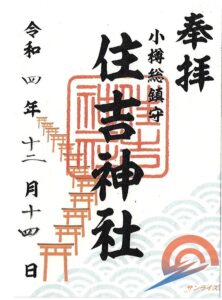
1.Red ink stamp-note

Original Red ink stamp note.
Price 2,000yen
2.Red ink stamp
Office time: 9:00~17:00
Price: 500yen Double-page red ink stamp is 1,000yen.
You can receive it at the shrine office on the left after passing through the second torii from the entrance.
It will be handled in writing.
3.The history
In the first year of Genji (1864), Shigekata Kikuchi, the priest of Hakodate Hachimangu Shrine, applied to the Hakodate magistrate’s office to appoint Sumiyoshi Okami as the general guardian of both Otarunai'' andTakashima” places, and the temple and shrine magistrate’s office has already been contacted. In June 1865, he was allowed to go to the place nearest to Otarunai Ungaya.
In 1866, the shogunate requested an appropriate location for the shrine land near the headquarters, and ordered the staff of the Otarunai government office to mobilize ships entering the port of Otaru to fill in the beach below the headquarters. I decided to create a company site.
However, due to the reforms of the Meiji Restoration, construction of the shrine grounds was canceled halfway through, so it was decided to temporarily enshrine it at Itsukushima Shrine in Yamanoue Town, and in 1868, the shrine was protected by Ukyo Kato, a shrine worker, and left Hakodate. Arrived on August 3, 1868, and held the enshrinement ceremony and the serenity memorial festival at both ‘Otarunai’ and ‘Takashima’ places.
In 1869, the shrine was moved from Itsukushima shrine to 28 Ryotoku-cho, and in 1875 it was ranked as a village shrine, and the festival was held grandly every year along with the development of Otaru.
Immediately after the fire in 1881, permission was granted to move to the current location when the road was revised in Ryotoku-cho. It used to be called Sumie Shrine, but in January 1892 it was renamed Sumiyoshi Shrine. In June 1898, permission was obtained to increase the precincts and rebuild the shrine, and construction began in 1899. In November 1906, it was promoted to a prefectural shrine, and in 1955, it was designated as a separate shrine for the main shrine.
In 1995, to commemorate the 130th anniversary of the enshrinement, restoration of the largest Mikoshi in Hokkaido, “Hyakkan Mikoshi”. In 2007, to commemorate the 140th anniversary of the enshrinement, a mikoshi storehouse was built to enshrine five portable shrines and one horse-drawn carriage. (Quoted from HP)

4.Traffic access
Location:2-5 Suminoe, Otaru-city, Hokkaido.
Nearest station: JR Hakodate Line Minamiotaru station alighting on foot 10 minutes
Parking:Can be.
URL: http://www.otarusumiyoshijinja.or.jp/index.html